
User delight is one of the most talked-about goals in UX design
But also one of the hardest to define and achieve.
Why?
Because delight is not a fixed outcome.
It is not just when a user smiles, enjoys an animation, or gives positive feedback. It is deeper than that.
Different users experience delight in different ways — and even the same user can feel different types of delight in a single interaction.
This makes it difficult for designers and businesses to measure and intentionally create it.
That is why modern human centered experience design that builds loyalty in Minnesota focuses not only on usability, but also on emotional impact across the entire user journey.
What is User Delight in UX Design?
User delight refers to any positive emotional response a user experiences while interacting with a product.
But here is the key idea:
👉 Usability is the foundation
👉 Delight is the emotional layer built on top of it
A product cannot be delightful if it is not usable first.
However, usability alone is not enough.
That is why leading ui/ux design services in Minnesota focus on both function and emotion.
Why User Delight Feels Difficult to Define
User delight is hard to measure because:
- It is subjective
- It changes from person to person
- It changes based on context and emotion
- It can happen in different forms at the same time
For example:
A user might:
- Like how a product looks
- Feel it is easy to use
- Connect with its purpose
All of these are different types of delight happening together.
This complexity is why professional ui ux design services in Minnesota, as IconicTek provides, require both psychology and design thinking.
The 3 Core Types of User Delight
To understand user delight properly, we break it into three levels.
1. Visceral Delight (First Impression)
This is the instant emotional reaction when a user sees a product.
It is based on:
- Visual design
- Colors and layout
- Overall aesthetic feel
Humans naturally respond positively to clean, balanced, and visually pleasing designs.
👉 First impressions matter because they shape trust immediately.
That is why creative ui ux services in Minnesota invest heavily in visual clarity and design consistency.
But visual appeal alone cannot sustain delight.
2. Behavioral Delight (Ease of Use)
This is the most important layer in UX design.
It refers to how easy and smooth it is for users to complete tasks.
A product creates behavioral delight when:
- Tasks are simple
- Navigation is clear
- Actions feel effortless
- Users do not feel frustrated
Example:
A simple app that works smoothly is often preferred over a beautiful but complicated one.
👉 If something looks great but is hard to use, users will leave.
This is why intuitive & user focused ui/ux design that drives results in Minnesota focuses heavily on usability and flow.
3. Reflective Delight (Meaning & Identity)
This is the deepest and most powerful form of delight.
It is about how users feel after using a product.
It connects to:
- Personal values
- Identity
- Long-term goals
- Emotional satisfaction
Example:
Two products may work the same, but a user chooses the one that aligns with their beliefs or goals.
This is why modern ux & ui design and consulting services in Minnesota focus on emotional connection, not just functionality.
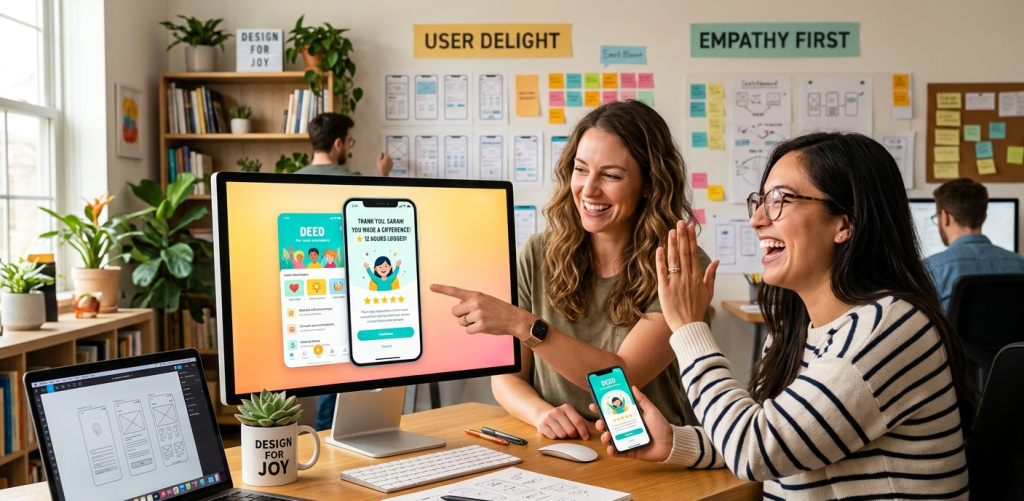
Why All 3 Types Must Work Together
User delight becomes weak or incomplete when only one layer is focused on.
Common UX mistakes:
- Beautiful UI but confusing usability
- Easy interface but emotionally flat experience
- Meaningful product but poor design execution
Real delight only happens when all three layers work together.
That is why leading ui ux design companies in Minnesota design complete experience systems, not just screens.
Why Short-Term Delight Fails Over Time
Many products try to create “instant delight” using:
- Animations
- Popups
- Gamification
- Visual effects
But this often fails in the long run.
Why?
Because users:
- Get used to it
- Stop noticing it
- Become frustrated if usability is poor
This is called surface-level delight.
Real success comes from long-term emotional satisfaction, not temporary excitement.
The Importance of Long-Term Experience Design
Strong UX design focuses on long-term user needs, not just first interactions.
For example:
Instead of building an app that simply “tracks fitness,” a better approach is to build one that helps users:
- Build healthy habits
- Stay consistent
- Improve lifestyle
- Stay motivated over time
This creates deeper emotional attachment and stronger retention.
This is what separates average apps from successful products designed by ecommerce ui/ux experts service in Minnesota and SaaS UX teams.
Emotional Design and Real User Context
One important UX principle is:
You cannot force emotion on users.
Users are humans with real situations:
- Stress
- Loss
- Frustration
- Distraction
- Emotional pressure
So adding playful or “happy” design elements in the wrong context can feel inappropriate.
Good UX design adapts to the user’s emotional state instead of forcing a mood.
This is a key principle in advanced human centered experience design that builds loyalty in Minnesota.
How UX Teams Evaluate User Delight
User delight cannot be measured with one metric.
It requires a combination of:
Qualitative methods (most important)
- User interviews
- Observational studies
- Real usage testing
- Diary studies
These help understand why users feel something.
Quantitative methods (supporting data)
- Surveys (CSAT, NPS, SUS)
- Analytics (clicks, time, behavior)
- Biometric signals (advanced research)
These help understand what users are doing, but not always why.
Best UX decisions combine both.
This is standard practice in ui ux design services in Minnesota.
Key Insight: Stop Designing for “Delight” Directly
One of the most important ideas in UX design is:
You do not create delight directly.
Instead, you create:
- Clear goals
- Smooth interactions
- Emotional relevance
- Long-term value
Delight becomes the result — not the goal itself.
Final Thoughts
User delight is not a simple design feature.
It is a combination of:
- Visual impression
- Ease of use
- Emotional connection
- Long-term value
When all three align, users do not just use a product — they enjoy using it.
That is the foundation of modern human centered experience design that builds loyalty in Minnesota.
Conclusion
If businesses want to improve digital experiences, they should not chase “delightful UI tricks.”
Instead, they should focus on:
- Understanding users deeply
- Reducing friction
- Designing meaningful experiences
- Building long-term trust
That is how real user delight is created — and sustained.
Request a quote online directly and quickly, and let experts reach out to you or contact IconicTek’s professionals by sending your query to them.